Achievement Pressure: What’s So Wrong With Being an Overachiever?
Originally published: 2023-10-29 · Updated: 2026-11-12
You might be the one who always pushes harder, does more, and holds yourself to a higher standard than anyone else. On the outside, it can look like success. On the inside, it can feel like pressure you can’t turn off.
I know this pattern from the inside. I am an overachiever, currently navigating what I call “achievement management.” A good bit of my work, both as a therapist and in my own healing, has involved understanding how this takes hold and how to loosen its grip.
So, what’s so wrong with being an overachiever? Achievement itself isn’t the problem. The trouble begins when you no longer feel free to stop, rest, make a mistake, or believe that what you’ve done is enough.
When Does High Achieving Become a Problem?
There’s room for ambition, hard work, and wanting to do something well. But the pattern I’m talking about comes with rigid expectations and a hefty emotional price. Your worth starts to depend on the outcome. A B feels like an F. A workout done three times instead of five feels like failure. Finishing a project isn’t enough; you have to over-finish it.
Perfectionism often sits underneath this pressure. The standard becomes “just right,” with little room for uncertainty or ordinary human mistakes. You may accomplish a great deal and still feel inadequate, because your brain is already measuring you against the next expectation.
A question I come back to with clients is: Am I enough if I don’t achieve perfection, my goals, or my own inner expectations?
I can hand someone a hundred good cognitive challenges, but if they don’t actually believe them, they’re just nice sentences. The work is learning to hold a different belief about yourself, then practicing it in the places where achievement has been running the show.
Signs You Might Recognize in Yourself
I see clients with long lists of accomplishments who have no idea this pattern is contributing to their distress. Their drive feels good, necessary, even essential for life. See if any of this sounds familiar:
Only the outcome counts. Reasonable effort doesn’t feel like enough unless the result meets your standard.
You check, recheck, and replay. Work, school, workouts, and even conversations become opportunities to search for mistakes.
Relief doesn’t last. You reach the goal, feel better briefly, and immediately move on to the next thing.
Your history of success doesn’t reassure you. Failure still feels right around the corner.
Your schedule leaves little room to be human. Rest, laughter, and activities with no productive outcome keep getting pushed aside.
Relationships get pulled into the pressure. You have less time for connection, seek repeated reassurance, or expect the people you love to meet the same standards.
These are patterns to get curious about, not another checklist to perform perfectly.
Why Can’t I Just Stop?
Family members sometimes say, “Just stop.” If only it were that easy.
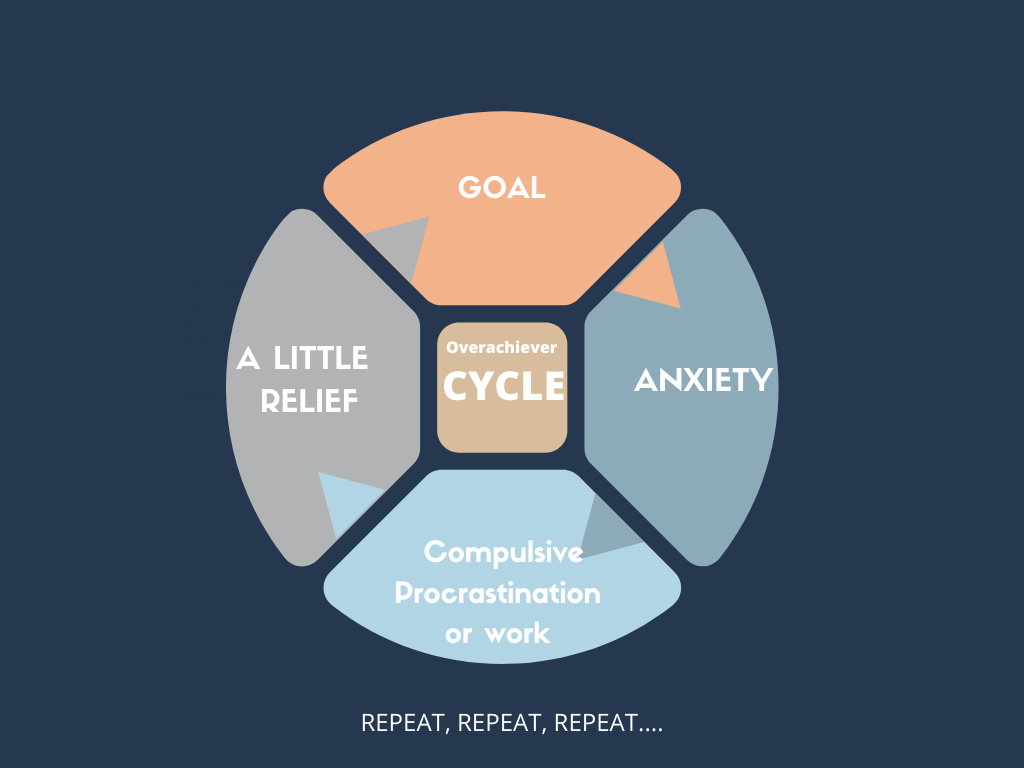
For some people, overachieving takes on a compulsive quality. You feel anxious, work harder or check again, and get a little relief. Your brain learns to repeat whatever brought that relief, even when the habit is exhausting you.
The loop can look like this:
A goal or expectation → anxiety about the outcome → overworking, checking, or avoidance → brief relief → the next expectation.
Procrastination can belong to this same pattern. If starting means facing the possibility of doing something imperfectly, putting it off offers a temporary escape. Then the deadline gets closer, the pressure grows, and you’re back to working harder under even more stress.
That’s why understanding the behavior matters. The question isn’t only “How do I become more productive?” It’s also “What feeling am I trying to manage by doing this?”
What Is Overachieving Giving You—and What Is It Costing?
Let’s be honest about both sides. Not the sanitized version, the real one.
Achievement can offer structure, purpose, praise, and a temporary sense of control. It can feel deeply connected to your values and identity. Giving it up may sound less like changing a habit and more like losing part of yourself. I understand that fear.
But take an equally honest look at the cost:
Your energy and rest: exhaustion, trouble switching off, and sleep sacrificed to unfinished work or racing thoughts.
Your emotional life: anxiety, irritability, self-criticism, and a mood that rises or falls with your latest performance.
Your relationships: missed time together, reassurance-seeking, or conflict over expectations.
Your work: difficulty delegating, overchecking, and spending more time on a task without making it meaningfully better.
Your enjoyment: little space for hobbies, spontaneity, or actually feeling satisfied with what you’ve accomplished.
One tool I borrow from Dialectical Behavior Therapy (DBT) is writing out the pros and cons. What does this way of living do for you in the moment? What does it cost over time?
You don’t have to solve the whole thing today. Imagine having even two percent more freedom to stop when you want to. That’s worth getting curious about.
My Own Story: When My Body Made the Decision for Me
I wish I could say a moment of profound inner wisdom led me to rein in my own overachieving and gracefully begin the process of change.
The truth is, I didn’t choose to slow down. My body decided for me when illness left no alternative. At first, I resisted fiercely. Flat-out refused to yield. Tried to power through. It took months of fighting my body’s clear signals before I recognized that surrender wasn’t weakness. It was my path forward.
Looking back, I can laugh at the stubborn streak that has defined me since childhood. For my body to give out, it had to endure so much. It had to endure me.
The roots of my own overachieving were tangled up in developmental trauma I carried without understanding its weight. It took years to recognize how those early experiences fueled the anxiety driving my perfectionism. Trying to push against the anxiety only took me so far. I also needed to tend to what was underneath it.
EMDR and my personal favorite, DBR (Deep Brain Reorienting), have been important parts of my own healing. Monthly therapy continues to help me unpack the trauma and the overachiever urges that still feel ingrained. If I’m not willing to practice what I preach, I’m not really on this path for the long haul.
My experience isn’t a promise that someone else’s healing will look the same. I share it because knowing better and doing differently are two very different things. I’m practicing, too.
Eight Steps to Manage Overachieving
Here’s where I’d start. Please don’t turn this into eight more things you have to get right by Friday.
1. Notice the Pattern Before You Obey It
Pay attention to the moments when “I want to” turns into “I have to.” What happened just before the urge to keep working, check again, or avoid starting? What are you afraid it would mean if you didn’t follow that urge?
Keep a brief reminder of why you want things to change. On the days achievement feels rewarding, it helps to remember the rest of the picture.
2. Get to Know Your Emotional Mind
Notice when anxiety, shame, or fear is making the decisions. A feeling can be powerful without being a reliable instruction. In DBT, “wise mind” makes room for both emotion and reason, so you can choose a response rather than automatically following the pressure.
Ask yourself: What would reasonable effort look like here, given the actual task and the rest of my life?
3. Address Anxiety and Depression Directly
If you’re using achievement to manage emotional discomfort, another accomplishment may only bring another short break from it. Make room to talk about the anxiety or depression itself. Therapy, practical skills, and other care when appropriate can help you work on what the overachieving has been trying to contain.
4. Make Space for Your History
For some people, doing more became a way to feel safe, valued, or less vulnerable to criticism. Exploring that history can help you understand why slowing down feels so threatening. It doesn’t mean every overachiever has a trauma history. It means your own history deserves attention.
If trauma is part of your experience, trauma-focused therapy may belong in your treatment plan alongside changes to everyday habits.
5. Build Rest Into Ordinary Life
Rest can’t always be the reward waiting at the end of a finished list. That list has a way of growing.
For me, learning to approach sleep with curiosity instead of frustration has mattered. I’m still experimenting with what helps my body settle, rather than treating every disrupted night as another failure.
Movement has required some humility, too. When my doctor suggested scaling back my high-intensity workouts, I was horrified. Gentle walking felt almost absurd to someone who loved grueling endurance sports. These days, my “old lady walks” have become some of my favorite moments of connection, with myself or a walking partner. My body needed something different from what my overachiever brain preferred.
6. Make Room for Fun With No Productive Outcome
When was the last time you laughed until your stomach hurt or spent time with someone without a deadline hovering over you?
Some mornings, my version is a car dance party. Rap, EDM, whatever grabs me, turned up loud on the way to wherever I’m headed. Yours might be prayer, a podcast, or simply being with someone you enjoy. I call it “growing happiness”: making room for actions that cultivate joy instead of waiting until everything is finished to feel it.
7. Give the Workday an Ending
Reserve the last ten to fifteen minutes to review what needs attention and make a realistic plan for tomorrow. You don’t have to solve every problem before leaving. Give unfinished work a place to wait.
Then try a small transition: close the laptop, change out of work clothes, or put your phone aside for dinner. Practice letting the workday end, even when your brain would prefer another hour.
8. Practice With Support
A therapist can help you choose manageable changes, notice when the old rules sneak back in, and make room for the feelings that follow. Trusted people can offer connection without becoming another source of repeated reassurance.
Start with one small change. You’re learning a different relationship with achievement, not competing to become the best person at balance.
How Therapy Can Help Break the Cycle
Alongside DBT, I use Exposure and Response Prevention (ERP) when compulsive checking, avoidance, or perfectionistic rules are maintaining the problem.
We identify situations that trigger the urge, then practice responding differently in gradual, appropriate steps. That might mean finishing an ordinary task at a reasonable standard, skipping an unnecessary extra check, and allowing the uncertainty to be there without immediately fixing it.
I sometimes call this “surfing the overachieving urge.” You notice it, name it, and practice letting it move through without automatically obeying it. The point isn’t to guarantee a perfect outcome—or even to make the anxiety disappear on command. It’s to build more freedom in how you respond.
The approach needs to fit the person. Some people also need care for anxiety or depression, work on longstanding beliefs, or trauma-focused treatment. We look at what is actually keeping your pattern going.
You Are More Than What You Accomplish
You don’t have to give up your drive, your values, or the goals that matter to you. But you deserve room to rest, connect, make mistakes, and enjoy a life that isn’t measured only by what you produce.
For those of us who have spent years proving ourselves through achievement, that can take practice. Small, messy, human practice. I’m right there with you.
At KDH Counseling, we help people work through anxiety, perfectionism, and the pressure to keep doing more. Explore therapy in Lafayette and through telehealth in Louisiana, or reach out to our team to talk about where you’d like to begin.
Further reading: Understanding Unhelpful Perfectionism from the International OCD Foundation.
