Many of the individuals I work with (myself included) are plagued by an obsessive brain. What is OCD? Obsessive Compulsive Disorder brains are repetitive and stuck, living in a rabbit hole of thinking that leads to nowhere but feels real to the sufferer. These individuals are often diagnosed with OCD, which is composed of obsessions followed by compulsions.
Do I have OCD?
OCD Thought Patterns: How the Cycle Keeps People Stuck
Many of the individuals I work with (myself included) live with an obsessive brain. Obsessive-Compulsive Disorder isn’t just about “liking things a certain way.” OCD brains are repetitive, sticky, and convincing-pulling people into a mental rabbit hole that leads nowhere, yet feels painfully real to the person experiencing it.
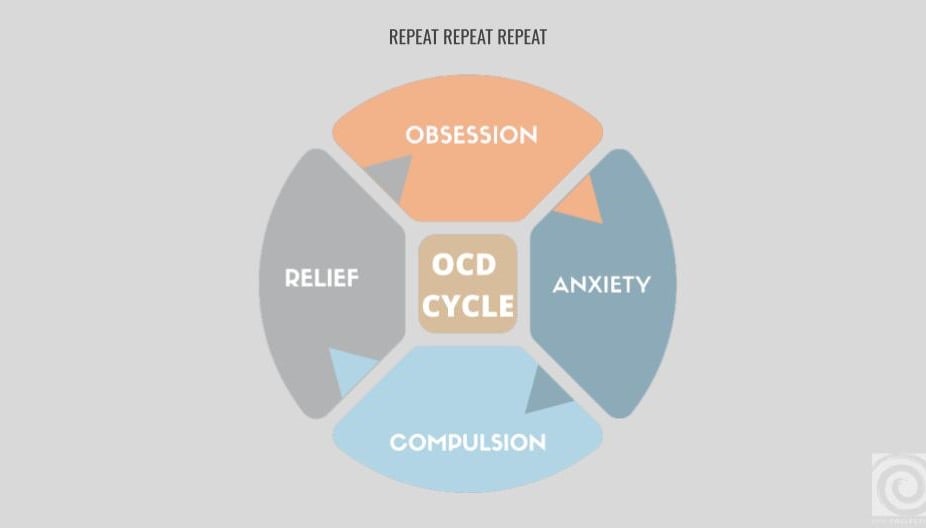
At its core, OCD is made up of obsessions followed by compulsions. Together, they form a cycle that feeds itself through anxiety.
Obsessions are distressing repetitive thoughts that are terrifying, where the individual gets lost by thinking the unwanted thought over and over again.
-
Fear of being contaminated or contaminating others with germs/ dirt/ others "energy" (a very common one)
-
Fear of harming yourself/others by losing control - some have a fear of being a serial killer or killing someone in their sleep, or fear of killing their baby accidentally
-
Intrusive sexually explicit or violent thoughts and images (Intrusive images just pop into the person's head, when the individual does not want to think about them)
-
Fear of sexuality - if you are straight, fear of being gay, if you are gay fear of being straight
-
Excessive focus on religious or moral ideas- often called scrupulosity.
-
Fear of losing or not having things you might need
-
Order/symmetry or just right: the idea that everything must line up “just right,” can be content not related to symmetry but needing the feeling of everything being just right
-
Superstitions; excessive attention to something considered lucky or unlucky
-
Fear of being a pedophile- and thus harming children even though you do not want to
-
Fear of making mistakes
The repetitive thoughts are triggered by anxiety and create more anxiety, and are followed by compulsive internal thoughts, actions, or external actions that are repeated = compulsions. In order to be a compulsion, it has to be done a lot, not just once or twice.
Common Compulsions:
-
Repeatedly checking to make sure that doors/windows are locked or that appliances are turned off; Can also be internal- sensation checking inside your body, or checking with others
-
Excessive cleaning of the house/clothes/body
-
Counting objects, letters, words, or actions
-
Doing routine activities repeatedly, like standing up or going up and down stairs
-
Requesting or demanding reassurance from family members or health care providers, such as "My hands should be clean now, right?", or through researching online
-
Repeating phrases or sequences of words either out loud or mentally
-
Rearranging objects to ensure a specific order and/or symmetry
-
Confessing about possible wrongs to others or perceived wrongs one has committed
-
Avoidance- can be done compulsively to avoid anxiety
-
Overworking tasks and school assignments (common in overachievers and perfectionism)
Triggers
Triggers for the obsessions are sometimes external and sometimes internal.
For some, feeding into the compulsion relieves the anxiety momentarily but then produces more anxiety, and so the cycle continues, and the obsession repeats forever, so it would seem. S/he/they becomes lost in these obsessions and compulsions.
For others, their compulsions relieve anxiety and keep it at bay, like a preference on how to live. These individuals have strict rituals that they feel they must adhere to, so their anxiety stays at bay.
Both types, for lack of a better word, are controlled by their obsessions and compulsions.
The funny thing is that we exaggerate this term so easily, much like we do with depression. “I’m obsessing,” or “I am so OCD about my workouts or my home.” This is not truly Obsessive Compulsive Disorder.
OCD is
True OCD is all-consuming and feels so real to the sufferer. Others will tell the individual to just stop thinking that way or doing your compulsions. If only it were that easy.
I do not have diagnosable OCD but my Generalized Anxiety Disorder presented like OCD when I was younger. I would obsess or ruminate over physical ailments, then compulsively research.
My trigger was disturbing news from my doctor. My doctor would mention things that needed to be checked out (possibly cancer) and then I would experience repetitive, uncontrollable thoughts about cancer (obsessions), research cancer symptoms online and sensation check in my body (compulsions).
I also obsessed/ ruminated over making mistakes at work and in social interactions. I would follow it by memory checking of events, scenario bending, and checking with friends to gain reassurance.
There are some individuals whose anxiety is compulsive in nature, but they do not have OCD because they don't meet all the DSM criteria, but it is still treatable the same way with ERP. I am one of those humans. Discovering ERP in my work life created lots of empathy and understanding for myself and for helping my clients.
Stop the Cycle With ERP
Fortunately, there is hope! OCD is a completely treatable condition through Exposure Response Prevention and Inhibitory Learning. It requires facing the worst of one’s fears.
No problem, right? I am joking of course!
I am highly aware of the fact that this will be one of the hardest things you will do. Just remember you will be forever changed by the process, and you do not have to do it alone. I often say you once you learn something through practice (experience), you cannot unlearn it. Learning these new messages and experiences with your anxiety is life changing. This is inhibitory learning.
I empathize so much with my clients because beginning the work is hard, that is why I chose the picture below.
It means finding a trusted and skilled therapist to lead you down this path. One that checks in with hang-ups and finds where you feel comfortable to start the work.
Together we can:
- Identify your obsessions: e.g., having repetitive and/or bizarre thoughts that can be intrusive (which means it just pops into your mind).
- Identify compulsions, either internal or external tasks that relieve anxiety or keep it at bay but then create more anxiety.
And begin the ERP/Inhibitory Learning process!
OCD can make it feel like your mind is working against you-but with the right approach, that cycle can change.
At KDH Counseling, we specialize in treating OCD using Exposure and Response Prevention (ERP), helping you identify obsessions, reduce compulsions, and build a different relationship with intrusive thoughts over time. Treatment is collaborative and paced to meet you where you are, while still moving toward meaningful change.
We provide OCD therapy in Lafayette, Louisiana, with both in-person and telehealth options available.
If you’re ready to begin, you can explore our OCD services or schedule a consultation to get started.



 KD HOLMES, LPC, EMDR CERTIFIED, BTTI TRAINED : Jun 5, 2025, 8:24:32 AM