
 KD HOLMES, LPC, EMDR CERTIFIED, BTTI TRAINED
What Is Brainspotting and How It Can Help?
Discover how Brainspotting vs EMDR can be used more efficiently to work with trauma. What is Brainspotting? Brainspotting (BSP) therapy is a powerful...
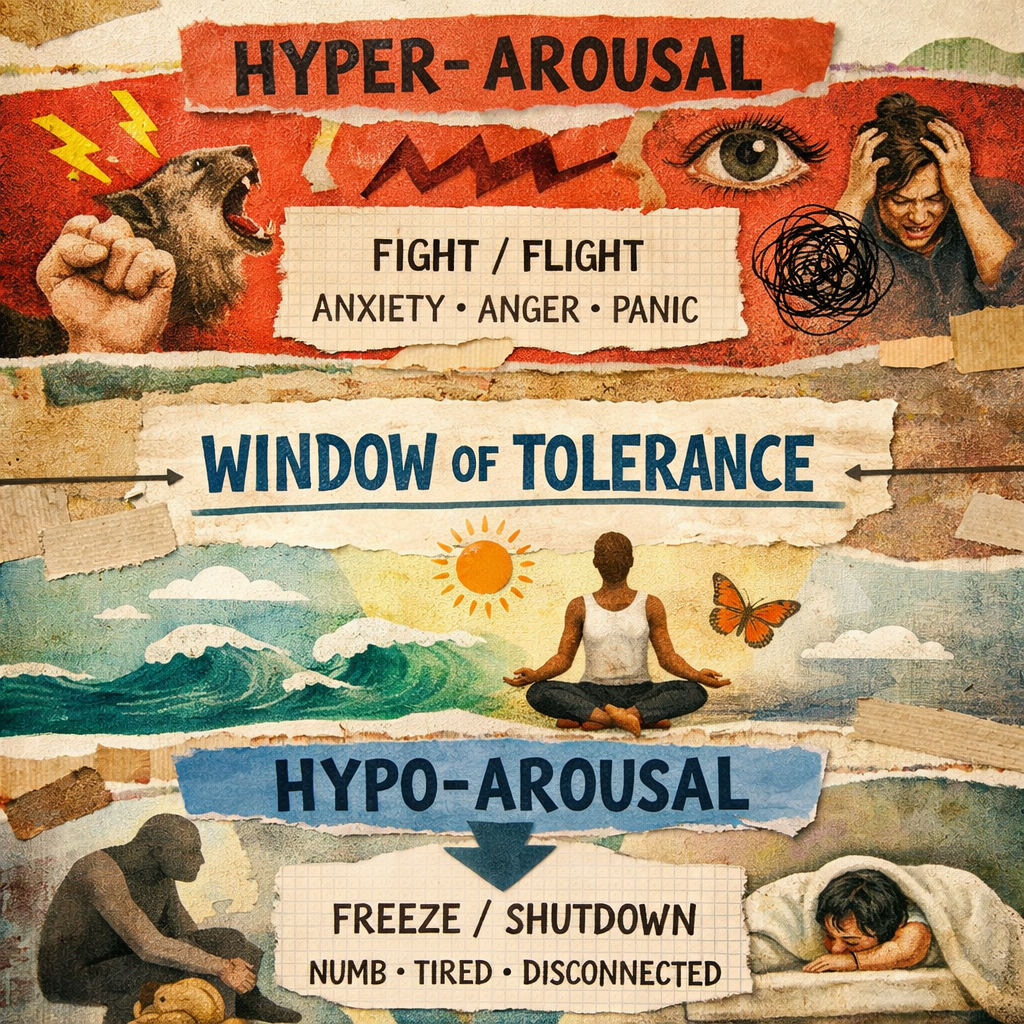
There are moments when your body reacts before you can think. Your chest tightens. Your breath shortens. Your mind tries to catch up to something that feels real. And somewhere inside, there is a quiet question: Why am I reacting like this? (Your feelings do not fit the facts.) This is sometimes years after a traumatic event. So how did this involuntary reaction begin?
Trauma is not just something that happened. It is something your nervous system learned.
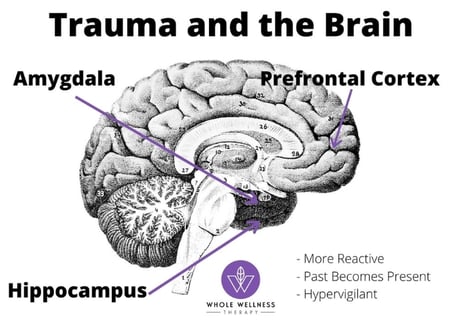
Deep in the brain, there is a structure called the amygdala. Its job is simple: detect danger and keep you alive. When something overwhelming happens, the amygdala activates quickly. Faster than thought. Faster than logic.
At the same time, the part of your brain that helps you think clearly-the prefrontal cortex-steps back. (I call this the thinking brain.) Not because it is broken. Because your body is prioritizing survival. Your body does not want to think run from the bear; it wants to keep you alive.
Your system shifts from: “What is happening?” to “How do I stay safe?” And your body begins to respond.
Your nervous system has different ways of protecting you. None of them are mistakes. They are adaptations.
This is the part of you that pushes back. You may feel:
Fight is your system saying, “I will not be overpowered.”
This is the urge to move away. You may notice:
Flight says, “If I keep moving, I will stay safe.”
This is the body slowing down when things feel too overwhelming. You may feel:
Freeze is not weakness. It is your system saying, “Pause. Conserve. Survive.”
This is the part that moves toward others to maintain safety. You may notice:
Fawn says, “If I stay connected, I will be safe.”
This is the part that shuts the system down when overwhelm becomes too much. It is often a deeper collapse response that can follow freeze. You may notice:
Flop says, “I can’t keep going. I need to shut down.” This response is not failure-it is your nervous system protecting you when activation has exceeded what feels manageable.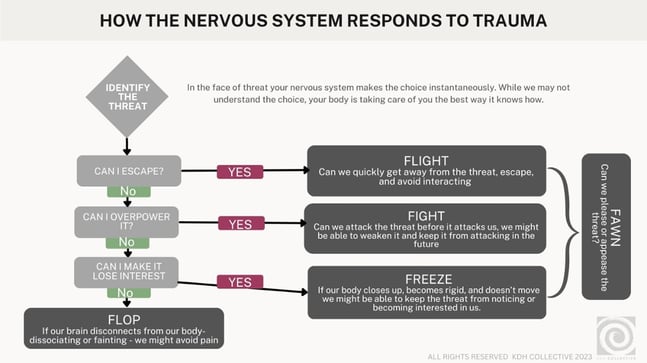
Trauma responses are not tied only to what happened. They are tied to what your body learned. If your system learned that certain situations were unsafe, it will continue to respond that way-even when the present moment is different.
This is why something small can feel big. Why your body reacts before your mind has context. Why it can feel like the past is still happening, your nervous system does not know that it is over. Your nervous system is not trying to confuse you. It is trying to protect you.
There is a range where your nervous system can process, think, and respond with flexibility. This is often called the window of tolerance. It is not a polyanna state of no stress. It is what your body can handle and still respond.
Inside that window, you can:
When trauma is present, that window can narrow.
-1.png?width=517&height=647&name=Advanced%20Trauma-informed%20Therapy%20(1)-1.png)
This is where anxiety, panic, and overwhelm live. You may feel:
This is where shutdown happens.
You may feel:
Your system moves between these states, trying to find safety.
At some point, these responses helped you. They were not random. They were intelligent adaptations to something that felt too much, too fast, or too overwhelming. Even now, your nervous system is not asking: “Is this logical?” It is asking: “Is this safe?” And responding accordingly.
Sensory differences influence how quickly the nervous system moves in and out of its window of tolerance. For some, everyday input like sound, light, or internal sensations can feel more intense, leading to quicker shifts into overwhelm or shutdown. These responses reflect how the system processes information, not a problem to be fixed. When understood, they offer a clearer path toward creating environments and strategies that support regulation and expand the window over time.
Healing from trauma is not about forcing your body to stop reacting. It is about helping your system learn something new. That safety can exist in the present. That sensations can be experienced without danger. That you can move through activation without being overwhelmed by it.
Therapy supports:
Over time, your system begins to shift. Not all at once. But gradually. From survival…toward steadiness. What I call stabilization. 
Trauma can shape how you experience your body, your thoughts, and your relationships. Support is not about “fixing” you. It is about understanding what your system has been carrying-and helping you respond to it differently.
At KDH Counseling, we provide:
Services are available in Lafayette, Louisiana and through telehealth across the state. If your reactions have felt confusing, overwhelming, or hard to understand, there is a way to make sense of them. And you don’t have to do that alone.

Discover how Brainspotting vs EMDR can be used more efficiently to work with trauma. What is Brainspotting? Brainspotting (BSP) therapy is a powerful...

 KDH Team : Mar 24, 2026, 10:11:02 AM
What Is EMDR Therapy? A nervous-system healing that starts with how humans process fear. People often arrive in therapy acutely aware of their...

Many people come into therapy looking for relief from their thoughts. They might say, “I just want to stop overthinking,” or “I want the anxiety to...